
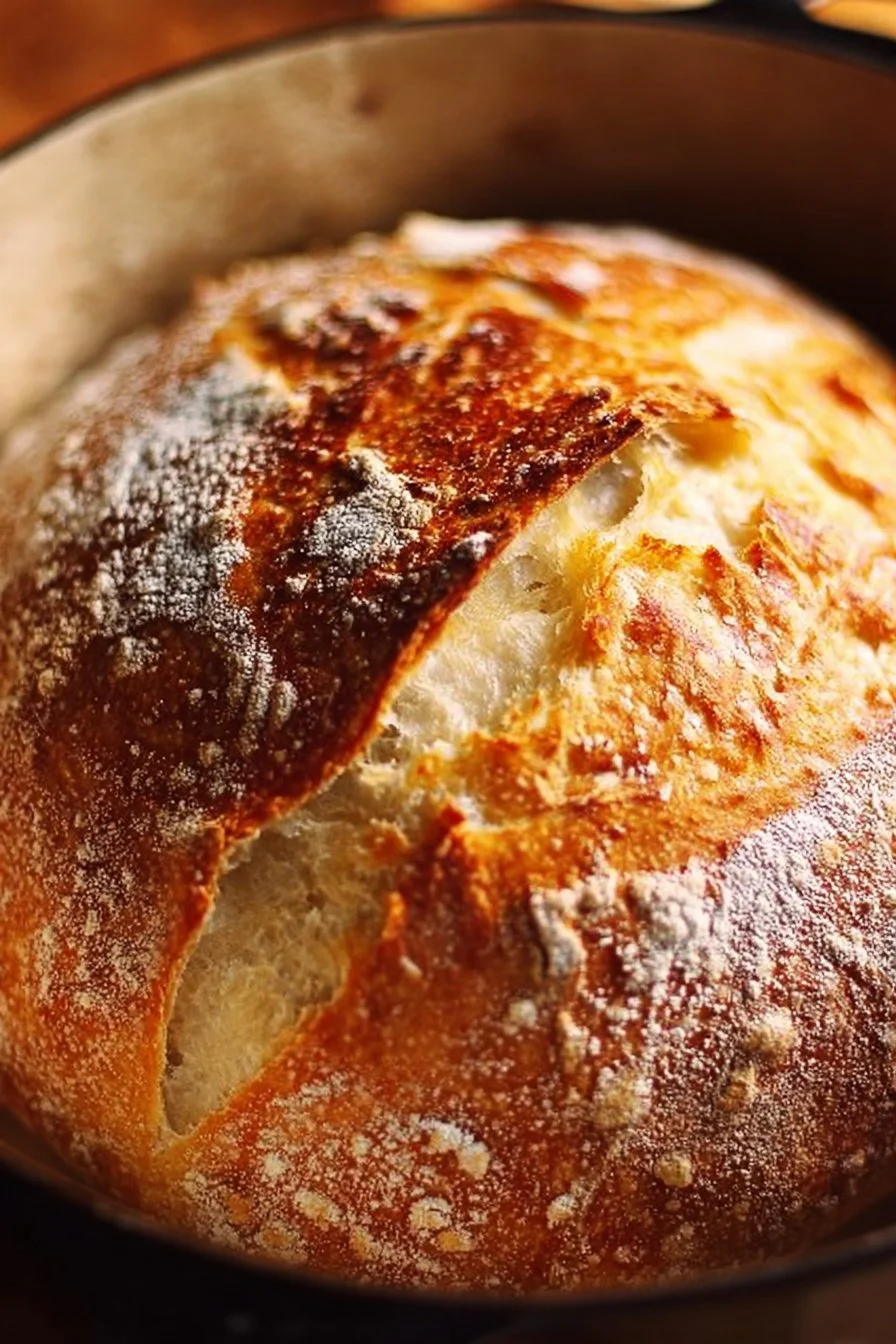
There’s something deeply satisfying about tearing into a loaf of crusty, homemade bread with a crackly exterior and a soft, open crumb inside. This Dutch oven no-knead crusty bread gives you that bakery-style result with minimal hands-on work — perfect for weeknight dinners, casual brunches, or as an impressive last-minute addition to a holiday table. If you want a straightforward method that relies on time, not elbow grease, try this recipe and read on for tips that guarantee a beautiful loaf every time. For more background on the technique, see this Dutch oven no-knead bread guide.
Why you’ll love this dish
This loaf is ideal when you want freshly baked bread without the usual kneading, shaping, or complicated steps. It uses minimal ingredients, requires only one bowl, and relies on a long, gentle rise to develop flavor and structure. The covered Dutch oven traps steam in the early baking phase, which is what creates that glossy, blistered crust you crave.
“We made this on a rainy Sunday — the house smelled like a bakery and everyone fought over the end pieces. Simple, reliable, and better than store-bought.” — home baker review
Perfect occasions: family dinners, soup nights, sandwich-making sessions, weekend baking projects, and gifting to friends or neighbors.
How this recipe comes together
This method is forgiving and easy to scan before you start. Here’s the quick flow:
- Mix warm water, yeast, and salt in one bowl.
- Add all the flour at once and stir until a sticky dough forms.
- Let the dough rise, undisturbed, until doubled (about 2–3 hours).
- Preheat a lidded Dutch oven to 450°F for 30+ minutes.
- Shape the dough on floured parchment, transfer to the hot pot, and bake covered, then uncovered, until deeply golden.
Timing overview: active hands-on time is about 10–15 minutes. Plan for roughly 3 hours total including rise and preheat.
What you’ll need
- 1 1/2 cups warm water (about 100°F) — lukewarm, not hot, to protect the yeast.
- 1 packet (2.25 teaspoons) active dry yeast — can be substituted with an equal measure of instant yeast (see FAQs).
- 1 1/2 teaspoons fine-grain salt — balances flavor and controls fermentation.
- 3 1/4 cups all-purpose flour — you can substitute up to 1 cup with bread flour for extra chew, or replace 1 cup with whole wheat for nuttiness (expect denser crumb).
Kitchen gear:
- Large mixing bowl
- Dutch oven with lid (cast iron preferred)
- Parchment paper
- Kitchen towel or plastic wrap
- Oven mitts (for handling very hot pot)
If you want more on Dutch oven choices and care, check out this page about Dutch oven bread techniques.
Step-by-step instructions
- Combine the liquid and yeast: In a large bowl, pour 1 1/2 cups warm water (about 100°F). Sprinkle 1 packet active dry yeast and 1 1/2 teaspoons salt into the water. Stir until dissolved.
- Add the flour: Dump 3 1/4 cups all-purpose flour into the bowl all at once. Mix with a sturdy spoon or spatula until a sticky, shaggy dough forms. The dough should be wet and tacky — that’s normal.
- First rise: Cover the bowl with a clean kitchen towel and leave it in a warm spot for about 2–3 hours, until it roughly doubles in size and looks puffed.
- Preheat the pot: Place your Dutch oven (lid on) into the oven and heat to 450°F for at least 30 minutes. This step creates the thermal shock and steam environment for a great crust.
- Shape: Lightly dust a piece of parchment with flour. Turn the risen dough onto the parchment and quickly shape it into a round by folding edges under; don’t overwork it. Trim excess flour off the top.
- Transfer to the pot: Using the parchment as a sling, lower the dough into the preheated Dutch oven. Cover with the lid.
- Bake covered: Bake for 35–40 minutes with the lid on. This traps steam and lets the crust set.
- Finish uncovered: Remove the lid and bake another 5–10 minutes until the crust is deep golden-brown and blistered. The loaf should sound hollow when tapped or reach an internal temperature around 200–205°F.
- Cool: Use oven mitts and tongs to lift the loaf (with parchment) onto a cooling rack. Let it rest at least 10 minutes before slicing to allow the crumb to set.
Safety note: Always use thick oven mitts when handling the preheated Dutch oven. Place the pot on a heatproof surface when removing from the oven.
Best ways to enjoy it
- Slice warm and spread with salted butter and honey for a simple treat.
- Serve alongside a hearty soup (tomato bisque, lentil, or vegetable stew).
- Use for sandwich making — this bread holds up to robust fillings like roast beef, melted cheese, or grilled vegetables.
- Make crostini: slice thin, toast under a broiler with olive oil, then top with tomatoes or ricotta.
- For entertaining, present the whole loaf on a wooden board with a small knife and compound butter.
Storage and reheating tips
- Room temperature: Keep the bread in a paper bag or wrapped loosely in a tea towel for 1–2 days. A plastic bag preserves softness but softens the crust.
- Freezing: Slice the cooled loaf, wrap portions tightly in plastic or foil, and freeze up to 3 months. Toast or bake slices straight from frozen.
- Reheating: For a revived crust, preheat oven to 350°F, spritz the loaf or slice with a little water, and bake 8–12 minutes. Avoid refrigerating — it accelerates staling.
- Safety: Cool completely before long-term freezing. Discard if you see mold or an off smell.
Pro chef tips
- Water temperature: Aim for about 100°F—warm to the touch but not hot. Too-hot water will kill the yeast; too-cool slows the rise.
- No-knead relies on time: The long rest lets gluten relax and develop without kneading. Don’t rush the rise.
- Flour handling: Use just enough flour to handle the dough; excess flour yields a tighter crumb.
- Scoring: A quick slash with a lame or sharp knife before placing in the pot can control where the loaf opens and give a more artisan look.
- Steam boost: If your oven is dry, place a small oven-safe dish of hot water on the rack below (not inside the Dutch oven) to add humidity.
- Doneness: If unsure, check internal temp (200–205°F) or tap the bottom for a hollow sound.
- Par-bake option: For softer crust, remove the lid 10 minutes earlier or reduce uncovered time.
Creative twists
- Herb & garlic: Fold in 1–2 tablespoons minced roasted garlic and 1–2 tablespoons chopped fresh rosemary or thyme.
- Seeded crust: Brush the loaf with water and press a mix of sesame, poppy, and sunflower seeds onto the top before baking.
- Cheddar and chive: Fold 1 cup shredded sharp cheddar and 2 tablespoons chopped chives gently into the dough for a savory loaf.
- Whole wheat swap: Replace up to 1 cup of all-purpose flour with whole wheat for a heartier taste. Add 10–20 minutes to bake time if needed.
- Sweet version: Stir in 2 tablespoons honey and 1/3 cup raisins for a slightly sweet breakfast loaf.
Common questions
Q: Can I use instant yeast instead of active dry yeast?
A: Yes. Use the same amount (2.25 teaspoons) of instant yeast and mix it directly into the flour if you prefer. The initial dissolve step isn’t necessary with instant yeast, but you can still proof in water if you like.
Q: How do I tell if the dough has risen enough?
A: The dough should roughly double and look puffy. A gentle fingertip press should leave an indentation that slowly springs back; if it springs back immediately, it needs more time.
Q: Can I bake this without a Dutch oven?
A: You can improvise by placing the shaped dough on a preheated baking stone and creating steam with a pan of hot water on the oven floor, but results vary—using a Dutch oven is the most reliable way to get that crackly crust.
Q: What if my loaf browns too quickly?
A: Tent loosely with foil for the remaining bake time after removing the lid, or reduce the final uncovered baking window by a few minutes.
Q: Is this recipe good for beginners?
A: Absolutely. The no-knead method is forgiving and perfect for first-time bread bakers. Follow the times and heat recommendations, and you’ll get consistent results.
If you want help troubleshooting a specific issue (dense crumb, flat loaf, overly chewy crust), tell me what happened and I’ll walk you through adjustments.
Print
Dutch Oven No-Knead Crusty Bread
- Total Time: 3 hours
- Yield: 1 loaf
- Diet: Vegetarian
Description
A simple, no-knead recipe for crusty bread that yields a beautiful bakery-style loaf with minimal effort.
Ingredients
- 1 1/2 cups warm water (about 100°F)
- 1 packet (2.25 teaspoons) active dry yeast
- 1 1/2 teaspoons fine-grain salt
- 3 1/4 cups all-purpose flour
Instructions
- Combine the liquid and yeast: In a large bowl, pour warm water and sprinkle yeast and salt. Stir until dissolved.
- Add the flour: Dump the flour into the bowl all at once. Mix until a sticky dough forms.
- Cover the bowl with a clean kitchen towel and let it rise for 2–3 hours until doubled in size.
- Preheat the Dutch oven (lid on) at 450°F for 30+ minutes.
- Shape the dough on floured parchment and transfer to the hot pot, then cover.
- Bake covered for 35–40 minutes to trap steam.
- Finish uncovered for another 5–10 minutes until golden-brown.
- Cool on a rack for at least 10 minutes before slicing.
Notes
Perfect for family dinners, serving with soup, or making sandwiches. Can be stored at room temperature or frozen for later use.
- Prep Time: 15 minutes
- Cook Time: 45 minutes
- Category: Baking
- Method: Baking
- Cuisine: Bread