
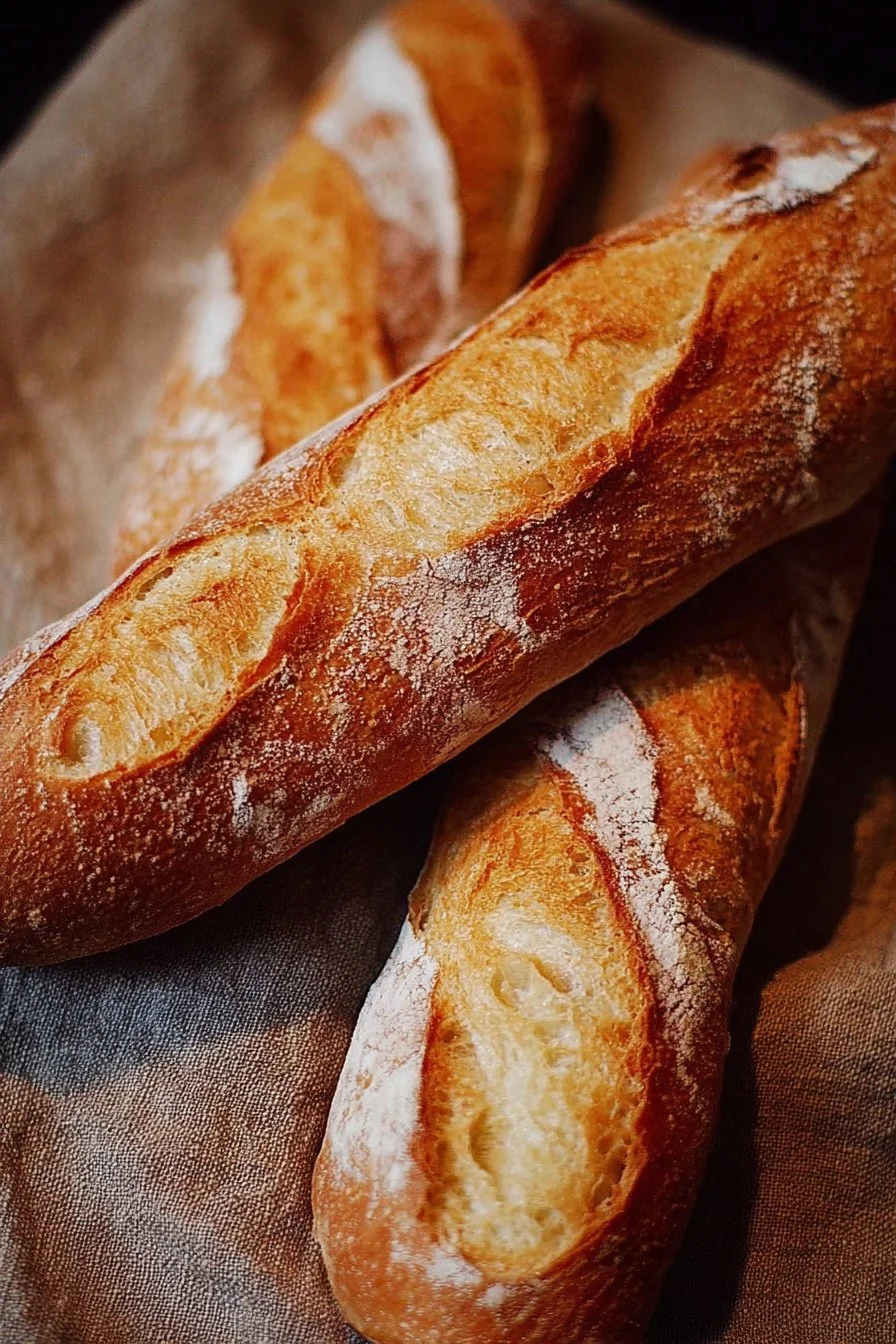
There’s something about a warm baguette that makes a meal feel thoughtful without being fussy: a crisp, crackling crust gives way to a soft, airy interior with just enough chew. This easy baguette recipe delivers that classic contrast using only four pantry ingredients and a few gentle hands-on moments—no complicated shaping, no long refrigeration. It’s perfect for slicing into rounds for bruschetta, tearing for dinner with a bowl of soup, or simply enjoying with butter and a sprinkle of flaky salt. If you want extra guidance or a printable version, check my Easy Baguette guide for more tips and photos.
Why You’ll Love This Easy Baguette
- Simple ingredients: just flour, warm water, salt, and instant yeast—pantry staples you likely already have.
- Impressive texture: crisp, golden crust with a soft, open crumb inside.
- Minimal fuss: only a few short rests and gentle folds—no kneading marathon.
- Fast-ish timeline: you’ll have fresh loaves in under two hours of active time.
- Versatile: perfect for sandwiches, soups, breakfast toasts, or a picnic loaf.
- Great beginner project: learn basic dough handling and shaping without intimidating techniques.
- Budget-friendly: homemade baguettes cost far less than artisan loaves from the bakery.
- Crowd-pleaser: makes an impressive centerpiece for weeknight dinners or casual entertaining.
What Is Easy Baguette?
An easy baguette is a simplified take on the classic French loaf. It’s long and tapered with a crisp exterior and a tender, slightly chewy interior. The flavor is clean and wheaty, with the salt and yeast bringing out subtle savory notes. This recipe uses a straightforward dough-mixing and folding method rather than extensive kneading or long cold fermentation, and the loaves are baked at high heat with steam to encourage a glossy, crackly crust. Baguettes are commonly served alongside soups, salads, cheeses, or charcuterie, and they’re the ultimate weekend baking project that doubles as comfort food and a casual showstopper.

Ingredients for Easy Baguette
For the dough
- 4 cups all-purpose flour
- 1.5 cups warm water (about 105–115°F / 40–46°C)
- 2 teaspoons salt
- 1 packet instant yeast
Ingredient Notes (Substitutions, Healthy Swaps)
- All-purpose flour: You can experiment with part bread flour for a chewier crumb (substitute up to 1 cup bread flour without changing hydration). For whole wheat, replace no more than 1 cup with whole wheat flour to avoid a dense loaf.
- Instant yeast: If using active dry yeast, proof it briefly in the warm water (add a pinch of sugar if you like) until foamy, then proceed—this recipe is written for instant yeast so you can mix it directly with the dry ingredients.
- Warm water: Temperature matters—too cool and the yeast is sluggish, too hot and you’ll kill it. Aim for 105–115°F (40–46°C).
- Salt levels: The recipe calls for 2 teaspoons; you can reduce to 1.5 teaspoons for a lower-sodium loaf, but the flavor will be milder.
Step-by-Step Instructions
Follow these 6 clear steps to turn a shaggy dough into beautiful loaves.
Step 1 – Mix the dry ingredients
- In a large bowl, combine 4 cups all-purpose flour, 2 teaspoons salt, and 1 packet instant yeast until evenly distributed.
Visual cue: The dry mix should look uniform—no clumps of salt or yeast.
Pro cue: Add the salt and yeast to opposite sides of the bowl if you’re worried about direct contact before adding water; instant yeast tolerates direct mixing, but this helps if you’re cautious.
Step 2 – Add the water and form the dough
2. Pour 1.5 cups warm water into the bowl and stir until a shaggy dough forms.
Visual cue: The dough will look rough and sticky, not smooth—this is expected.
Pro cue: Use a wooden spoon or dough whisk; resist the urge to add more flour. The dough should be tacky.
Step 3 – Rest and fold the dough
3. Cover the bowl and let the dough rest for 20–30 minutes. Then reach under the dough, lift it, fold it over itself, rotate the bowl, and repeat 4–6 times. Repeat this folding process once or twice during the rest.
Visual cue: After resting and folds, the dough will feel firmer and hold its shape better, with some visible air bubbles.
Pro cue: Folding builds structure without kneading—think of it as training the gluten gently. Keep your hands lightly floured to prevent sticking.
Step 4 – Shape the loaves
4. Turn the dough out onto a floured surface, divide it into equal portions, and shape each into long, tapered loaves.
Visual cue: Each loaf should be elongated with slightly tapered ends and a smooth surface.
Pro cue: For better tension, roll each portion away from you, pinching the seam on the bottom so the top stays smooth.
Step 5 – Proof the loaves
5. Place shaped loaves on a floured surface to proof for 30–45 minutes until slightly puffy.
Visual cue: The loaves will look a bit fuller and spring back slowly when gently pressed.
Pro cue: Proof time depends on room temperature; a warmer kitchen shortens proofing. Don’t overproof—loaves should still feel slightly springy.
Step 6 – Bake with steam
6. Preheat the oven to 450°F (230°C) and prepare for steaming. Bake the loaves for 18–25 minutes until golden brown and hollow sounding when tapped on the bottom. Let cool briefly before slicing.
Visual cue: The crust will be deep golden-brown and glossy; tapping the bottom should yield a hollow sound.
Pro cue: Steam in the first 8–12 minutes helps the crust expand and crisp—use a hot pan with water or toss ice cubes into a preheated tray (be careful to avoid burns). Rotate loaves once during baking if your oven has hot spots.
Pro Tips for Success
- Use a scale when you can: even though the recipe uses cups, weighing ingredients gives more consistent results.
- Temperature matters: keep your water within the recommended range to wake up the yeast without killing it.
- Don’t over-flour during shaping: a lightly floured surface is enough—too much extra flour will dry the dough and lead to a denser crumb.
- Steam is essential: it delays crust formation so the loaf can expand fully; simulate steam with a metal tray and boiling water if you don’t have a spray bottle.
- Watch for the hollow tap: oven color varies—use the hollow sound test and visual cues rather than relying solely on time.
- Be gentle with folds: the goal is to build structure, not to deflate the dough. Light, confident movements work best.
- Cool briefly before slicing: cutting into a piping-hot loaf can compress the crumb; a 10–15 minute rest keeps textures intact.
Flavor Variations (Optional)
- Garlic-herb baguette (optional): After shaping, brush the tops lightly with olive oil and sprinkle with minced garlic and dried herbs—bake as directed.
- Seeded crust (optional): Lightly brush the loaves with water and press sesame or poppy seeds onto the surface before baking.
- Olive or sun-dried tomato (optional): Fold a small handful of chopped olives or sun-dried tomatoes into the dough during the first fold.
- Cheesy twist (optional): Add grated hard cheese into the dough or sprinkle on top during the last 5 minutes of baking for a savory finish.
- Everything-bagel style (optional): After shaping, brush with an egg wash (or water for a vegetarian option) and sprinkle an everything blend on top.
(These variations are optional add-ins and won’t change the core dough; use modest amounts to avoid weighing the dough down.)
Serving Suggestions
- Slice and toast for simple breakfast toasts topped with butter, jam, or avocado.
- Serve with a bowl of warm soup—tear-away pieces are perfect for dunking.
- Build rustic sandwiches: ham and cheese, roasted vegetables, or a classic pan bagnat-style sandwich.
- For a casual appetizer, slice into rounds, brush with olive oil, and broil briefly to make crostini.
- Use as a base for bruschetta topped with tomatoes, basil, and a drizzle of olive oil.
- Pair with a cheese board, olives, and pickles for an easy entertaining platter.
- For a fun combo, serve hot baguette slices alongside an amazing loaded fries recipe to create a playful, shareable spread for game day or parties.
Make-Ahead, Storage & Reheating
- Make-ahead: You can mix, rest, and do the folding stages a few hours ahead, then shape and proof just before baking. For a slightly more developed flavor, proof shaped loaves in the refrigerator for up to 8–12 hours (bring back to room temp before baking).
- Refrigerator storage: Baked baguettes are best the day they’re made. Store in a paper bag or loosely wrapped in a kitchen towel at room temperature for 1–2 days for best texture.
- Reheating: Refresh stale baguette slices by sprinkling with a little water and warming in a 350°F (175°C) oven for 5–10 minutes. For a quick crisp, slice and toast under the broiler for 1–2 minutes on each side.
- Texture changes: The crust will soften after a day; reheating will bring back some crispness but won’t perfectly replicate fresh-from-the-oven texture.
Storage and Freezing Instructions
- Freezing: This dough freezes well at the shaped or fully baked stage. For shaped loaves, flash-freeze on a tray until firm, then wrap tightly and store in a freezer bag for up to 2 months. For baked loaves, slice first, wrap tightly, and freeze for up to 2 months.
- To bake from frozen (shaped): Thaw in the refrigerator overnight, then bring to room temperature and finish proofing before baking.
- To reheat from frozen (baked): Bake frozen slices at 350°F (175°C) for 10–15 minutes until warmed through and crisp.
- If you don’t want to freeze, consider making smaller loaves or sharing extras with friends—fresh baguette is always welcome!
Nutrition Facts (Per Serving)
| Calories | Protein | Carbs | Fat | Fiber | Sodium |
|———|——–|——|—–|——|——-|
| 218 kcal | 6 g | 46 g | 0.6 g | 1.6 g | 560 mg |
Nutrition values are estimates and may vary depending on ingredients and portion sizes.
FAQ About Easy Baguette
Q: Why is my baguette dense instead of airy?
A: Likely under-proofed or over-handled. Make sure the dough had time to rest and build structure with the prescribed folds, and avoid excessive flour when shaping.
Q: How do I know if my water is the right temperature?
A: Use a thermometer if possible—aim for about 105–115°F (40–46°C). If you don’t have one, water should feel warm but not hot to the touch.
Q: My crust cracked in odd places—what went wrong?
A: Crust cracking can be due to uneven shaping or insufficient steam. Ensure you create surface tension when shaping and introduce steam early in the bake.
Q: Can I slow the fermentation to develop more flavor?
A: Yes—while this recipe is designed for speed, you can proof shaped loaves in the refrigerator overnight to deepen flavor. Bring to room temp before baking.
Q: How do I tell when the baguette is done?
A: Visual color and a hollow sound when you tap the bottom are good indicators. Internal temperature should be around 200–210°F (93–99°C) if you use a thermometer.
Q: Will this recipe work at high altitude?
A: At high altitude, doughs can rise faster. Shorten proofing times and watch for the visual cues rather than strict timing; you may need a touch more water if the dough feels stiff.
Notes
- Slice at an angle for pretty presentation and more surface area for spreads.
- For an extra-shiny crust, brush with a little water or milk before baking; for an even crisper crust, skip the brush.
- Score the tops shallowly with a sharp blade to control expansion and create the classic baguette look.
- If you want deeper flavor, try a short cold ferment after the initial mix—plan ahead and adjust proofing time.
- Serve slightly warm for the best texture—freshly baked baguette is a simple pleasure that elevates any meal.

Easy Baguette
- Total Time: 55 minutes
- Yield: 4 servings
- Diet: Vegetarian
Description
An easy baguette recipe using four simple ingredients, delivering a crisp crust and soft interior, perfect for various meals.
Ingredients
- 4 cups all-purpose flour
- 1.5 cups warm water (about 105–115°F / 40–46°C)
- 2 teaspoons salt
- 1 packet instant yeast
Instructions
- Mix the dry ingredients: In a large bowl, combine flour, salt, and yeast until evenly distributed.
- Add the water and form the dough: Pour warm water into the bowl and stir until a shaggy dough forms.
- Rest and fold the dough: Cover the bowl and let the dough rest for 20–30 minutes, then fold it over itself several times.
- Shape the loaves: Turn the dough out onto a floured surface, divide it into portions, and shape into long, tapered loaves.
- Proof the loaves: Place shaped loaves on a floured surface to proof for 30–45 minutes until slightly puffy.
- Bake with steam: Preheat the oven to 450°F (230°C) and bake the loaves for 18–25 minutes until golden brown and hollow sounding when tapped.
Notes
For better flavor, proof shaped loaves in the refrigerator overnight. Slice at an angle for a beautiful presentation.
- Prep Time: 30 minutes
- Cook Time: 25 minutes
- Category: Bread
- Method: Baking
- Cuisine: French