
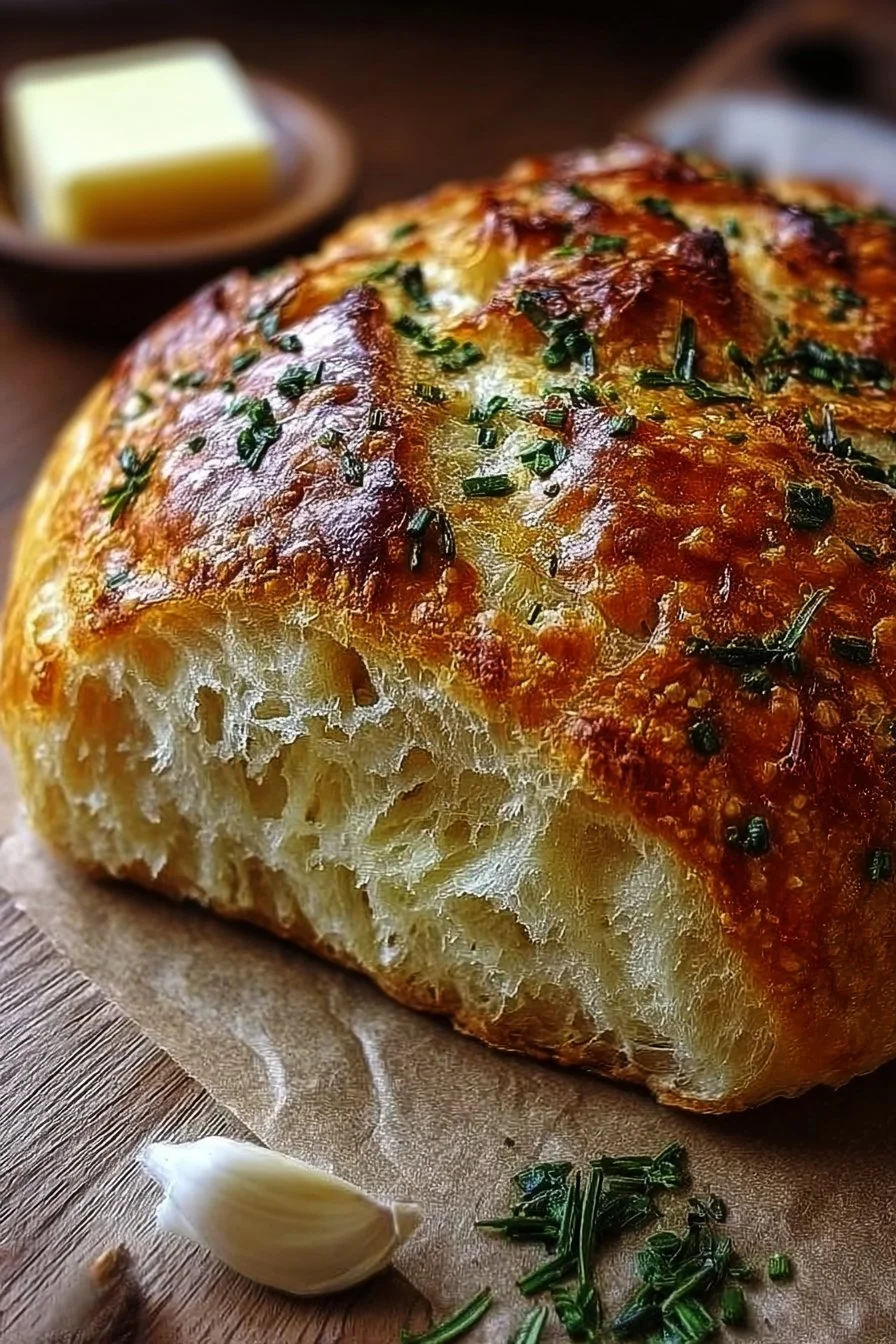
There’s something quietly satisfying about tearing into a steam-hot loaf straight from a Dutch oven: crisp, herb-scented crust, a tender open crumb and a garlicky finish that brightens everything it touches. This no-knead Garlic Herb Dutch Oven Bread is the kind of loaf you make when you want a rustic centerpiece without fuss. If you already love that homey, artisan feel, this version—with rosemary and thyme folded into the dough—is one to bookmark, and you can compare technique with my other notes on garlic herb Dutch oven bread for a deeper look at timing and texture.
Why you’ll love this dish
This recipe hits the sweet spot between rustic artisan bread and simple, everyday baking. It uses a long, slow room-temperature rise instead of hours of kneading, so you get complex flavor and open crumb with minimal hands-on time. It’s budget-friendly, uses pantry staples, and fits many occasions—weekend brunch, soup night, or a last-minute dinner centerpiece.
“I made this for company and everyone thought it came from a bakery—so simple and so impressive.”
Why people keep returning to this loaf: the garlic powder adds a consistent, mellow punch without raw garlic’s sharpness, and fresh herbs folded into the dough perfume every slice. The Dutch oven creates a steam chamber that gives the loaf a crackly crust and keeps the crumb moist.
The cooking process explained
This recipe is intentionally straightforward. You mix dry ingredients, add warm water to form a shaggy dough, and let time do the work. After a long bulk ferment at room temperature, you shape the dough, rest it briefly, then bake it in a preheated, oiled Dutch oven with the lid on to trap steam. Uncovering halfway through lets the crust color deeply. Expect about 12–18 hours of passive rising plus about an hour of active baking and resting.
What you’ll need
- 3 cups (about 375 g) all-purpose flour
- 1 teaspoon fine salt
- 1 teaspoon active dry yeast
- 1 teaspoon garlic powder (use more or less to taste)
- 1 tablespoon fresh herbs (rosemary, thyme, or a mix), finely chopped
- 1 1/2 cups warm water (about 95–105°F / 35–40°C)
- 1 tablespoon olive oil (for greasing the pot)
Notes and substitutions:
- Use instant yeast if that’s what you have—reduce it to 3/4 teaspoon and proceed the same way.
- For whole-wheat flavor, swap up to 1 cup of the all-purpose flour for whole wheat, but expect a denser crumb.
- If fresh herbs aren’t available, 1 teaspoon dried herbs will work; fresh gives a brighter aroma.
Step-by-step instructions
- In a large bowl, whisk together the flour, salt, yeast, garlic powder, and chopped fresh herbs until evenly combined.
- Pour in the warm water and stir with a wooden spoon or spatula until a shaggy, sticky dough forms. Don’t worry about a smooth surface.
- Cover the bowl tightly with plastic wrap or a lid. Let it rise at room temperature for 12–18 hours. The dough should double and be dotted with bubbles.
- When you’re ready to bake, place your empty Dutch oven (with lid) in the oven and preheat to 450°F (230°C). Let the pot heat for 30 minutes.
- Meanwhile, turn the dough onto a well-floured surface. Using floured hands, shape it into a round ball by folding the edges underneath to create surface tension. Let it rest on the counter, uncovered, for 30 minutes.
- Carefully remove the hot Dutch oven from the oven. Drizzle the bottom with the tablespoon of olive oil to prevent sticking and to crisp the crust.
- Transfer the dough into the hot pot (use oven mitts and a gentle hand). Score the top lightly with a sharp knife if you want controlled expansion. Cover with the lid.
- Bake covered for 30 minutes. Remove the lid and bake for another 15 minutes, or until the crust is deep golden brown and sounds hollow when tapped.
- Lift the loaf out and cool it on a wire rack at least 30 minutes before slicing so the crumb sets properly.
Safety tip: Always use heavy oven mitts when handling a preheated Dutch oven and keep children away from the hot appliance.
Best ways to enjoy it
Slice it warm with a pat of butter and extra flaky salt. It’s fantastic with:
- Olive oil and balsamic for dipping.
- Soft cheeses (brie, ricotta) or a smear of garlic-herb butter.
- Alongside a bowl of tomato soup, stew, or a hearty salad for a satisfying dinner.
For party service, tear into rustic chunks, place on a wooden board, and add small bowls of flavored olive oil, olives, and sliced cheeses.
Storage and reheating tips
Store at room temperature wrapped loosely in a linen bag or paper bag for up to 2 days to preserve crust texture. For longer storage:
- Freeze whole: wrap the cooled loaf tightly in plastic then foil for up to 3 months. Thaw at room temperature and re-crisp in a 350°F oven for 10–12 minutes.
- Freeze slices: separate with parchment and freeze in a zip-top bag; toast straight from frozen.
Reheating: For a fresh-baked crust, heat the whole loaf at 350°F for 8–12 minutes or pop slices in a toaster. Avoid refrigeration; it speeds staling.
Helpful cooking tips
- Measure flour by weight for consistent results. If using cups, spoon the flour into the cup and level—don’t pack it down.
- Warm water should feel like warm bath water—comfortable to the touch but not hot. Too-hot water kills yeast.
- Don’t over-handle the dough after the long rise; gentle shaping preserves the air pockets that create an open crumb.
- A well-heated Dutch oven is key — it creates steam and bounce. Preheat for at least 30 minutes.
- If you want more garlic aroma, brush the baked loaf with a little garlic-infused olive oil right after it comes out.
Creative twists
- Add 1/2 cup grated Parmesan or cheddar into the dough for a cheesy crust. For a full cheese-forward version, try the cheesy garlic herb bread for extra layers of flavor.
- Top the dough before baking with coarse sea salt and additional chopped herbs for a visual and textural boost.
- Make it spicy by folding in 1–2 teaspoons of crushed red pepper flakes or swapping rosemary for oregano and adding olives for a Mediterranean loaf.
- For a seeded crust, brush the dough with water and press sesame or poppy seeds before baking.
Common questions
Q: Can I shorten the 12–18 hour rise?
A: Yes, but flavor and texture will change. A 3–4 hour warm rise yields a decent loaf, but you’ll miss some of the complex, fermented flavors that develop during a long, slow rise.
Q: My dough is too sticky to shape—what do I do?
A: Lightly flour your work surface and hands. Avoid adding too much extra flour; use just enough to manage the dough. A wet bench scraper also helps move and shape sticky dough without tearing it.
Q: Can I use instant yeast?
A: Yes. Reduce to about 3/4 teaspoon of instant yeast. Keep the same timings—the long ferment is more about flavor than yeast quantity.
Q: Is this safe to leave out overnight?
A: Yes, it’s designed for a long room-temperature rise. If your home is very warm (above ~78°F / 26°C), shorten the rise to prevent overproofing, or refrigerate for a slow overnight ferment.
Q: Can I make this gluten-free?
A: Gluten-free baking requires special blends and binders; this recipe isn’t directly interchangeable. Look for a tested gluten-free no-knead Dutch oven recipe or use a high-quality all-purpose gluten-free flour blend with xanthan gum and expect a different texture.

Garlic Herb Dutch Oven Bread
- Prep Time: 15 minutes
- Cook Time: 45 minutes
- Total Time: 16 hours
- Yield: 1 loaf
- Category: Bread
- Method: Baking
- Cuisine: American
- Diet: Vegetarian
Description
A no-knead Garlic Herb Dutch Oven Bread with a crisp crust and tender crumb, infused with garlic and fresh herbs.
Ingredients
- 3 cups (about 375 g) all-purpose flour
- 1 teaspoon fine salt
- 1 teaspoon active dry yeast
- 1 teaspoon garlic powder
- 1 tablespoon fresh herbs (rosemary, thyme, or a mix), finely chopped
- 1 1/2 cups warm water (about 95–105°F / 35–40°C)
- 1 tablespoon olive oil (for greasing the pot)
Instructions
- In a large bowl, whisk together the flour, salt, yeast, garlic powder, and chopped fresh herbs until evenly combined.
- Pour in the warm water and stir with a wooden spoon or spatula until a shaggy, sticky dough forms.
- Cover the bowl tightly with plastic wrap or a lid and let it rise at room temperature for 12–18 hours.
- Preheat the oven to 450°F (230°C) with the empty Dutch oven inside for 30 minutes.
- Turn the dough onto a well-floured surface and shape it into a round ball.
- Let it rest uncovered for 30 minutes.
- Carefully remove the hot Dutch oven from the oven and drizzle the bottom with olive oil.
- Transfer the dough into the pot and score the top lightly if desired. Cover with the lid.
- Bake covered for 30 minutes, then remove the lid and bake for another 15 minutes or until golden brown.
- Cool on a wire rack for at least 30 minutes before slicing.
Notes
For best results, measure flour by weight. Store at room temperature for up to 2 days or freeze for longer storage. Avoid refrigeration to prevent staling.